Pages

Friday, February 25, 2005

Happy Birthday, Johnny

Tomorrow, 26 February 2005 would have been Johnny Cash's 73rd Birthday. In memory of Johnny I have written this poem:

A voice God would speak with
From a burning bush.
A man not consumed
By the ring of fire.
Hurt and then healed.
Like a Hebrew prophet
filled with the Spirit
Waiting for the man
To come around,
Carrying nothing
But the thought of You.

Thursday, February 24, 2005

Parashat Ki Tissa Commentary by Rabbi Schorsch

From JTS Distance Learning:

P A R A S H A C O M M E N T A R Y
Parashat Ki Tissa 5765
Exodus 30:11 - 34:35
February 26, 2005 17 Adar I 5765

Ismar Schorsch is the chancellor of The Jewish Theological Seminary.

Read the Parashah | Read the Haftarah

The jarring truth about the episode of the golden calf is that it occurred at Mount Sinai. The venue chosen for the giving of Torah quickly witnesses its violation. To be in the presence of the holy does not make one automatically holy. The sequence of the biblical narrative is freighted with philosophical profundity. At the very moment that Moses receives the "two tablets of the Pact, stone tablets inscribed with the finger of God" atop the mountain (Exodus 31:18), his people below lose faith in him and his abstruse deity. Unnerved by Moses's absence, the Israelites demand of Aaron: "Come make us a god who shall go before us, for that man Moses, who brought us from the land of Egypt - we do not know what has happened to him" (32:1). The peak experience of revelation at Sinai is unsustainable. Faithlessness follows close on the heels of miracles.

It is not the first time that the Torah takes us on a roller coaster. Time and again, its narrative sequence underscores the basic instability and disorder of human existence. Stasis appears to be beyond our grasp. The idyll of Eden lasts less than one generation. Sibling rivalry soon roils the tranquility that Jacob sought to find "in the land where his father had sojourned" after his reconciliation with Esau (Genesis 37:1). Nor do the exodus from Egypt and the passage through the Sea of Reeds imbue the Israelites with an unshakable faith in God. In the face of adversity, they plummet from the exultation of the Song at the Sea (az yashir) into three dark instances of grousing (Exodus 16-17).

The pattern recurs so often as to seem ineluctable. No high is for long. We catch merely glimpses of grandeur and perfection, no more. The sons of Aaron, Nadab and Abihu, meet their untimely death in the midst of the consecration of the Tabernacle (Leviticus 10:1-2). The earthly norm is far from the orderly and tranquil paradigm of cosmic creation as depicted by the Torah. It is that sober world view which prompts Jews to raise their voices in prayer endlessly and wearily that God who maintains the harmony of the heavens grace us on earth with an equal measure of harmony (a paraphrase of the last line of the Kaddish).

A remarkable midrash captures the mood of Moses when he first sees the religious debauchery unleashed by the golden calf. Prior to this moment, while still on the mountain, he had fervently pleaded with God not to abandon Israel. Now Moses is overcome by despair rather than anger. He senses the chasm between the divine ideal and the human reality. According to the midrash, he does not smash the tablets; they slip from his grasp. They have become too heavy to bear. As Moses beholds human nature in all its intractability, the letters desert the tablets. They return to heaven leaving the tablets infinitely heavier. Moses had signed on for a fool's errand. God's revelation soared beyond the capacity of humans to internalize and actualize. At best, brief interludes of nobility might punctuate extended periods of decadence (Torah Shlemah on 32:19).

But that is not the final word. Later Moses is granted a fleeting look at God's back from a crevice in the rock (Exodus 33:23). There, the Talmud claims, he saw God wrapped in a tallit like a precentor (a shaliah tzibur) modeling the prayer service. Each time Jews sin, God instructs Moses, they should avail themselves of this prayer service and I will forgive them. It is at this critical juncture that God introduces the principle of repentance (teshuvah). Human waywardness does not reduce God's compassion, which is why the thirteen divine attributes affirmed in our parashah (34:6-7) begin by repeating God's personal name twice. "I am God prior to a person's sinning and God afterward, provided that person has repented. Hence a compassionate and gracious God" (BT Rosh Hashanah 17b).

Reworked by the Rabbis, the saga of the golden calf spawns the seedbed for repentance. Depravity does not lead to determinism or fatalism but to the renewal of a covenant that joins God and Israel in a quest for human self-transcendence. Though we will never eradicate the passions that muddy or derail our lives, we can aspire to tame and harness them for good. Judaism is a regimen of religious practice designed to elevate and ennoble the dross we are dealt (Bereishit Rabbah 44:1).

But it is also much more. In the elaborate ritual of Shabbat, Judaism offers up a weekly foretaste of the peace and quiet that steadily elude us. I would like to think that it is no accident that right before the calamity of the golden calf, the Torah reiterates briefly the sanctity of Shabbat (Exodus 31:12-17). The chaos of history must not be allowed to obscure the tranquility of holiness. The Rabbis speak of Shabbat as a speck of eternity planted in our midst to remind us that we do not live in the best of all possible worlds (BT Berakhot 57b). To experience it is to reinvigorate our soul with a touch of eternity (BT Beizah 16a). Such is the transformative power of Shabbat, according to the Talmud, that if the Jewish people in its entirety were to observe it properly but twice in a row, they would merit immediate redemption (BT Shabbat 118b). The key to salvation is transcending ourselves.

Shabbat Shalom,

Ismar Schorsch

The publication and distribution of Dr. Schorsch's commentary on Parashat Ki Tissa are made possible by a generous grant from Rita Dee and Harold (z"l) Hassenfeld.


Copyright © 2004 Jewish Theological Seminary
Comments to learn@jts web team.

Tuesday, February 22, 2005

אורי און, the Jewish Superman

A while back I posted about the Jewish SuperHero Corps and a couple of Marvel and DC Comics's Israeli superheroes. I recently ran across another Israeli superhero: אורי און, the protaginist of the first Israeli comic book. Created by Michael Netzer, Jonathan Deutsch, and Yossi Halper in 1987 אורי און is essentially an Israeli version of Superman.

Temple Mount: No-prayer zone

From Religious News On-Line:

"Judaism considers it the holiest place on earth. Muslims say it's the third holiest. Christianity reveres the spot as being of great historic importance. But if someone prays there, if he or she is not Muslim, the worshiper will be immediately arrested. Welcome to the Temple Mount...

The Temple Mount was opened to the general public until September 2000, when the Palestinians started their intifada by throwing stones at Jewish worshipers after then-candidate for prime minister Ariel Sharon visited the area.

Following the onset of violence, the new Sharon government closed the Mount to non-Muslims, using checkpoints to control all pedestrian traffic for fear of further clashes with the Palestinians.

The Temple Mount was reopened to non-Muslims in August 2003. It is still open but only Sundays through Thursdays, 7:30 a.m. to 10 a.m. and 12:30 p.m. to 1:30 p.m., and not on any Christian, Jewish or Muslim holidays or other days considered "sensitive" by the Wafq, the Muslim custodians of the Temple Mount.

During "open" days, Jews and Christian are allowed to ascend the Temple Mount, usually through organized tours and only if they conform first to a strict set of guidelines, which includes demands that they not pray or bring any "holy objects" to the site. Visitors are banned from entering any of the mosques without direct Wafq permission.

Rules are enforced by Wafq agents, who watch tours closely and alert nearby Israeli police to any breaking of their guidelines.

WorldNetDaily was given a tour of the Temple Mount Tuesday along with several Christian archeologists. The small group was warned in advance not to bring Bibles and once on the Mount, not to whisper or make bowing movements for fear the Wafq might think a non-Muslim is praying in the area.

The tour guide, Nachman Kupietsky, an Orthodox Jew who covers his head with a baseball cap while in the area and not his usual yarmulke, for fear of being arrested, said, "These rules are very serious. They were made by the Waqf and agreed to by the Sharon government, which is not very religious and just doesn't want any more clashes on the Temple Mount."

Kupietsky told WND of instances in the past few months in which members of his tour group were arrested for breaking various rules.

He said a Jewish woman was detained last summer for putting her head down while sitting on a bench:

"It was a hot day and she just wanted to rest for a few minutes. The Wafq started screaming and the police arrested her. She told me she was held for six hours and had to sign documents stating she would never again return to the Temple Mount.

"You also can't bring anything with Hebrew letters, even secular Hebrew books. The Wafq confiscated many of my tour books. One time I brought a guy who pulled out the Hebrew edition of the [Jerusalem] Post, and they took that from him."

Kupietsky said Orthodox guests who decide to wear yarmulkes are routinely delayed by Israeli police at the entrance to the Temple Mount for up to 30 minutes while they are interrogated about the purpose of their visit.

Visitors were then brought to the steps of the Dome of the Rock and Al-Aqsa Mosque.

The Christians on the tour tried to enter the mosque, but rejoined the group minutes later saying a Palestinian in worship garb slammed the doors and told them to go away.

Kupietsky took out a picture book to show the disappointed Christians images of the interior sections of the mosque, but a Palestinian cleric who had been watching the tour demanded Israeli police confiscate the book, assuming it contained prayers. A scuffle ensued between the police, the cleric and Kupietsky, but it was finally determined the book contained no Hebrew lettering.

The group was brought further to Solomon's Stables. The Wafq recently excavated the area, and sections were made into a large, new mosque. The excavation and accompanying construction caused major damage to the eastern and southern sections of the Western Wall, which many experts say are now unstable and in need of repair.

Jewish and Christian archeologists charge the Wafq during the excavation disposed truckloads of dirt containing Jewish artifacts from the Temple period. After the media reported this, Israeli authorities froze the construction permit given to the Wafq. The remainder of the dirt now sits in a small garden outside the Al Aqsa Mosque...

Likud minister and leader of Israel's Manhigut Yehudit Party Moshe Feiglin told WorldNetDaily: "We gave away our sovereignty to the holiest place of the Jewish people. I can pray in Manhattan, Damascus, Cairo, but I cannot pray in my holiest place because of an Israeli decision. ... I think it's a disgrace that represents more than anything the deepest conflict that Israel deals with – not peace, not security or the Palestinians. It's the conflict between the Jews and themselves over what is going to be their national identity for the coming generations. This identity is represented more than anything else by the Temple Mount."

Yehuda Etzion, head of the Eternally Alive movement for Jewish rights on the Temple Mount, told reporters, "The worst thing is that there is coordination between the Waqf and the Israeli government."

Abu Mazen, now Palestinian president, called the tours "provocative" and Arab League Secretary-General Amr Moussa said the Christian and Jewish visits were "an insult to Muslims everywhere."
Read the rest of this article at WorldNetDaily.

Wednesday, February 16, 2005

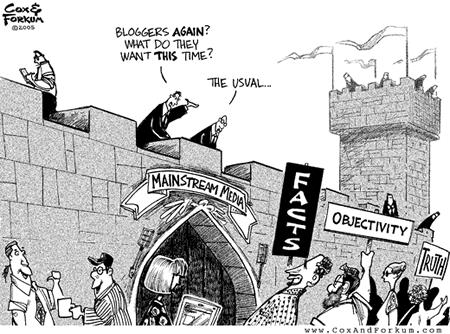
What Do Bloggers Want?

Also from Honest Reporting
(Its from the second story down, titled Big Media Under Scruitiny)

Posted by Hello

The BBC's Inspiring Thought

From Honest Reporting.com:

Every morning at 7:45, BBC Radio provides listeners with an inspiring 'Thought for the Day' from a religious cleric or philosopher. On the program's February 10 edition, Rev. Dr. John Bell (at right) used the platform to describe an Arab-Israeli acquaintance of his ― 'Adam' ― who was

conscripted into the Israeli Army. There he had distinguished himself as a good soldier and was made a corporal. He was also imprisoned for refusing to shoot unarmed schoolchildren.

Through our BackSpin weblog, HonestReporting encouraged subscribers to notify the BBC that 1) Arab-Israelis are not 'conscripted' into the IDF (though some volunteer to serve), and 2) the claim that the IDF orders officers to 'shoot unarmed schoolchildren' ― under penalty of imprisonment ― is outrageous, libelous, and completely unsubstantiated.

In response to letters of protest, BBC removed Bell's sound clip and transcript from its online archives ― but not before HonestReporting captured the transcript on our weblog (as publicized through the popular COP 'Daily Alert').

BBC has since issued an official apology for not 'fact-checking' that Israeli-Arabs are not conscripted. However, neither Bell nor the BBC has retracted the libelous claim ― broadcast to millions worldwide ― that the IDF would order an officer 'to shoot unarmed schoolchildren.'

Comments to BBC Radio: click here

Friday, February 11, 2005

Biblical Fonts

Jim West has assembled an impressive collection of Biblical Study related fonts on his Biblical Studies Resouces page.

Thursday, February 10, 2005

Terumah Torah Commentary from Rabbi Schorsch

From JTS Distance Learning :

P A R A S H A C O M M E N T A R Y
Parashat Terumah 5765
Chancellor Ismar Schorsch
Exodus 25:1- 27:19
February 12, 2005 3 Adar I 5765

Ismar Schorsch is the chancellor of The Jewish Theological Seminary.

Read the Parashah | Read the Haftarah

In Hebrew it is customary not to pronounce the name of God as written. The roundabout expression is a mark of awe and respect. Thus in the world of contemporary Orthodoxy people usually refer to God as hashem , the name, short for shem hameforash, the explicit name of God, which has long been studiously avoided. Put simply, God is the Being with a holy name. An excess of intimacy would violate God's grandeur. The sobriquet frees us to speak often and personally about God without disrespect, allowing us to bring the God of the cosmos into our everyday lives.

The same dynamic is evident in our parashah which speaks of God as residing in the Tabernacle. God orders Moses to instruct the Israelites to "make Me a sanctuary that I may dwell among them" (25:8). The verb to dwell, shakhon, gave rise in rabbinic Judaism to a new name for God, Shekhinah, the One Who Is Indwelling. It appears early on in the second-century Aramaic translation of this verse by Onkelos: "And you should make before Me (rather than for Me) a sanctuary that I may cause My Presence (Shekhinah) to dwell among them." Clearly, Onkelos was prompted to soften the unsettling concreteness of our verse with a degree of separation.

He did so elsewhere when the depiction of God was too human for comfort. At the meal which concluded the covenant at Sinai, the Torah reports that the leaders of the Israelites "beheld God, and they ate and drank" (Exodus 24:11). Onkelos, however, chose to paraphrase: "They saw the glory of God and rejoiced in the reception of their sacrifices as if they were eating and drinking." Similarly, when Moses ascended Mount Sinai for a second time. "The Lord passed before him and proclaimed" (Exodus 34:6). Again, Onkelos introduced a remove, "and the Lord passed His Presence (Shekhinteh) before him and proclaimed."

In his meticulous work on the thought of the Rabbis, Professor Ephraim Urbach showed just how widespread the term Shekhinah became in rabbinic parlance. If a husband and wife enjoy a happy union, then the Shekhinah dwells in their midst. Or God chose a lowly bramble to confront Moses to make the tangential point "that there is no spot on earth devoid of God's Presence (Shekhinah)". Or the induction of a gentile to Judaism is described as coming "under the wings of the Shekhinah (Hazal, pp. 34-37).

Theology is what drove this change in nomenclature. How can we conceive of God as both transcendent and immanent? Our knowledge of the universe demands a Creator who is grand, majestic and remote; our insufficiency pleads for a God who is nearby and caring. The profusion of divine names in Judaism attests to the many ways in which we humans experience God. As Shekhinah, God is accessible, convinced and supportive. A midrash imagines Moses to be astonished by God's command to erect an abode for God here on earth. "Lord of the universe, behold the heavens in all their expanse cannot contain You and You say 'Make Me a sanctuary!' But the Holy One, may He be blessed, responded: 'Moses, you misconstrue what I ask. Just take twenty planks for the north side and twenty for the south and eight for the west. And I will come down and contract My Presence (Shekhinati) to be with you below.'" (Pesikta de Rav Kahana, ed. by Mandelbaum, p. 33).

In other words, transcendence and immanence are not mutually exclusive. Having painted the big picture, God does not walk away from the details. God's grandeur is not lessened by remaining engaged by what God has wrought. Yet another midrash manages the polarity with an unforgettable image. The Tent of Meeting in which God will henceforth speak to Moses is akin to a cave at the seashore. When the sea rushes in at high tide to fill it, the sea is not diminished in the least (Pesikta de Rav Kahana, p. 4).

Judaism never cut the Gordian knot. It stubbornly refused to sever the polarities. The history of its theology is an unending struggle to be true to heart and mind, to a divine reality that is intimate yet infinite, loving yet beyond reach. The retention of polarities acknowledges the complexity of existence. For depth, we need two lenses. The paradigm, according to Rabbi Yohanan, is already firmly established throughout Scripture. "Wherever you find a reference to God's transcendence (gevurato), you will also find a reference to God's immanence (anvetanuto)." Whereas a single prooftext from Scripture is usually enough to affirm a proposition, R. Yohanan provides us with three, one from each section of the Tanakh, as if to put the polarity of transcendence and immanence beyond dispute. Whenever the Bible comes to speak of God's grandeur, it immediately references the comfort of God's grace (BT Megillah 31a).

And, indeed, the Siddur turns on the juxtaposition of the two. At the beginning of the morning service, we orient ourselves by meditating on the magnificent Ibn Gabirol poem, Adon Olam, which moves effortlessly from reason to faith. Uninhibited by the truisms of philosophy about the nature of God, the poet asserts midway through that his personal God and Redeemer is the eternal and incomparable God of creation. God's tender love enables him to live without fear.

Prior to the Shema, in Ahavah Rabbah, we ask God to unite our hearts in the love and fear of God's name. But can we do both at once? Only if we realize that it is God's grandeur that imbues us with the emotion of fear, just as God's grace fills us with love. A single state of mind cannot do justice to our experience of God's manysidedness.

Finally, in the opening berakhah of the silent Amidah, we approach God in the spirit of R. Yohanan as: "Great, mighty, awesome, exalted God who bestows loving-kindness." Grandeur and grace are the complementary keys in which God becomes palpable in our lives.

Shabbat shalom,

Ismar Schorsch

The publication and distribution of Dr. Schorsch's commentary on Parashat Terumah are made possible by a generous gift from Rita Dee and Harold (z"l) Hassenfeld.


Copyright © 2004 Jewish Theological Seminary
Comments to learn@jts web team.

Wednesday, February 9, 2005

I Used To Believe

I Used to Believe: The Childhood Belief Site
"i used to believe is a collection of ideas that adults thought were true when they were children. it will remind you what it was like to be a child, fascinated and horrified by the world in equal parts. the following pages will reassure you that the things you used to believe weren't so strange after all..."
A very interesting and entertaining site. Not suprisingly I found the section on religion most enjoyable. The site is interactive and they encourage readers to submit childhood beliefs.

Maimonides and Marcus Aurelius

I was reading excerpts from Maimonides' Mishneh Torah this week for my 'Classics of the Jewish Tradition' class and I ran across this passage:

"A man should always regard himself as if his death were iminent and think that he may die this very hour, while still in a state of sin. He shouldn't therefore repent of his sins immeadiately and not say, "When I grow old I shall repent," for he may die before he becomes old. So Solomon, in his wisdom, said, "Let your garmets be always white, and oil on your head not be lacking" (Eccles. 9.8)."
- Mishneh Torah Chapter 7.2, from I Twersky's Maimonides Reader.
Which immeadiately brought to mind this passage from Marcus Aurelius' Meditations:
"Do not act as if thou wert going to live ten thousand years. Death hangs over thee. While thou livest, while it is in thy power, be good."
- Meditations, Book 2, Translation by George Long
I wonder of there is any connection. Maimonides was well versed in Greek philosophy, but I'm not sure that the Meditations were widely available at this time. Interesting parallel none the less.

Tuesday, February 8, 2005

Three Strikes

Three Strikes
For Michael Thomas Cunningham, 1967-2005
by John W. Leys

When you took ill
I prayed for you.
Every day I prayed.
Three times a day:
Morning, noon and night
I begged for God’s mercy;
Begged for a miracle

But the time for prayer is passed
Mourning is now here.
Enriched by your memory,
Wounded by your absence.
Nothing will bring you back,
Your miracles are spent.

The path you walk
I will one day follow,
But you can never follow it
Back to me.

Monday, February 7, 2005

Quote for the Day

"Genuine religious movements do not offer man the solution of the world mystery but equip him to live from the strength of the mystery; they do not instruct him about the nature of God but show him the path on which he can meet God"
- Martin Buber, 1935

Saturday, February 5, 2005

Forged Antiquities a Danger to Israel?

Jim West points out an article that speculates that the recent spate of forged antiquities in the Holy Land may be used as fodder for those wishing to undermine Jewish claimes to Israel:

Indictments in a sophisticated antiquities forgery ring have cast a pall over the entire field of biblical archaeology and could provide new arguments for those seeking to delegitimize Jewish claims to the Holy Lan.

That's because religious leaders and even governments use the presence or absence of archaeological discoveries to bolster their claims to truth and territory, or to refute someone else's... [Read the Full Article]

UPDATE: Jim Davila has this to say on the article:
I have noted elsewhere how the Jewish-temple deniers are playing the story for their own purposes. The financial damage the forgers have caused pales in comparison to the damage they have done to the serious archaeology and history of the biblical period.

Three Strikes

On Thursday morning, 24 Shevat / 03 February, my cousin Michael Thomas "Zeke" Cunningham passed away after a seven year battle with ALS (Aka Lou Gehrig's Disease). His obituary, courtesy of the funeral home website, is as follows:

Michael Thomas ''Zeke'' Cunningham
July 10, 1967 - February 03, 2005
Birthplace: East Rockaway, New York
Resided In: Albany OR USA
Service: February 10, 2005

Michael ''Zeke'' Cunningham was born in East Rockaway, New York, the son of James and Patricia (Leys) Cunningham. He moved to Albany in 1978 and attended Waverly Elementary School, North Albany Middle School and graduated from West Albany High School in 1986. He went to Oregon State University and played football, graduating in 1991. Mike married Janelle Lierman on August 8, 1987 in Oakville, Oregon. He had almost completed his Master's Degree through OSU when he contracted ALS. He taught at North Albany Middle School for 4 years and then went to West Albany High School where he taught and coached football, wrestling and track.
Mike enjoyed building as a hobby, but his passion was football and following OSU athletics. He loved West Albany High School, both kids and staff. In the summers, he installed sprinkler systems, built fences and other projects with his brother. His brother, Jim, named his company WIN Construction after Mike's motto: ''Whatever Is Necessary''. He traveled extensively while seeking treatment for ALS, including: Vermont, Maine, Los Angeles, San Francisco, Mexico, Nassau, Progue and Germany. He died Thursday in Albany after his long battle with ALS.
Mike was a member of the Oakville Presbyterian Church, where he served as an Elder.
He is survived by his wife, Janelle, daughters, Jenna and Ashton, and his mother, Patricia Spoon, all of Albany, brother, Jim Cunningham of Beaverton, and sisters, Helen Williams of Albany, Kim Bardin of Lebanon and Patti Geer of Long Island, New York. He was preceded in death by his father.
Memorial services will be held at 4:00pm, Thursday, February 10th at the West Albany High School Gymnasium. Contributions may be made to West Albany High School Athletics or The Cunningham Children's Scholarship Fund, which is being set up for the benefit of Mike's children, c/o Fisher Funeral Home, 306 SW Washington, Albany, Oregon
Mike was an inspirational person, both before and after being diagnosed with ALS. In the face of his own mortality he never gave up & I never once doubted him when he said he would find a way to beat the disease. He had a sprit and determination that made you believe. But sadly you can only stand at the plate for so long before you're either on base or walking back to the dugout. No third strike has ever hurt quite so much.

אני הלך אליו והוא לא־ישוב אלי

”I shall go to him, but he will never return to me”
- 2 Samuel 12.23

Thursday, February 3, 2005

How Hard Could It Be?

From KinkyFriedman.com:

Kinky Friedman Campaign Poster
With the Alamo as his backdrop, musician-turned-mystery author Kinky Friedman launched an independent, and unconventional, campaign Thursday to run for Texas governor in 2006.

He announced his candidacy just after sunrise, saying, "We're going to wake up this great slumbering giant of Texas independence."

Friedman is campaigning against what he calls the "wussification" of Texas, which he defines as political correctness run amok. He favors legalized casino gambling to finance education and would push for life without parole as an alternative to the death penalty...

riedman, joking he wants to move into the governor's mansion "because I need the closet space," launched his drive to become the state's first independent governor since Texas Revolution hero Sam Houston in 1859 in front of the Alamo.

Wearing a black cowboy hat and sporting a trademark lit cigar, Friedman's announcement was carried nationally on the MSNBC morning show hosted by radio personality Don Imus...

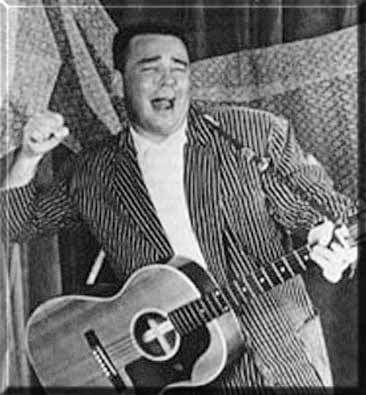
The author of numerous books, columns and songs he performed with his bar band "The Texas Jewboys," Friedman, 60, stressed he'll use humor to frame a serious candidacy in the Republican-dominated state.

"Don't worry about my lack of experience," Friedman said. "Trust me. I'm a Jew. I'll hire good people."

On the 169th anniversary of Lt. Col. William B. Travis' arrival at the Alamo, which would eventually fall to Mexican troops, Friedman laid out his plan to begin the "de-wussification of Texas."

"I'm not anti-death penalty. I'm anti-the wrong guy getting executed," Friedman said. "Two-thousand years ago we executed an innocent man named Jesus Christ and we don't want to make another mistake like that." ...

Like Minnesota's Jesse Ventura in 1998 and California's Arnold Schwarzenegger in 2003, Friedman's nontraditional candidacy could garner serious support, said political analyst Larry Hufford of St. Mary's University in San Antonio.

"I think Kinky can make the candidates deal with issues they don't want to talk about," Hufford said

Kinky's Official Store offers a wide variety of campaign materials:


Further info on Kinky and his campaign can be found at his Official Website - http://kinkyfriedman.com/

The Day the Music Died

The image “http://www.buddyholly.com/photos/publicity/_w/buddy014_jpg.jpg?nav=pho” cannot be displayed, because it contains errors.

Buddy Holly
(Charles Hardin Holley)
7 September 1936 - 3 February 1959


The image “http://www.rockabillyhall.com/RitchieVgtr.jpg” cannot be displayed, because it contains errors.
Ritchie Valens
(
Richard Steven Valenzuela)
13 May 1941 - 3 February 1959

The image “http://www.hotshotdigital.com/OldRock/TheBigBopper.Images/bopper1.jpg” cannot be displayed, because it contains errors.
J.P "The Big Bopper" Richardson
(Jiles Perry Richardson)
24 October 1930 - 3 February 1959

The image “http://www.hotshotdigital.com/WellAlwaysRemember/Buddy.Images/plain.jpg” cannot be displayed, because it contains errors.

Wednesday, February 2, 2005

And?

From JTS Distance Learning:

P A R A S H A C O M M E N T A R Y
Parashat Mishpatim 5765
Exodus 21:1-24:18
February 5, 2005 26 Sh'vat 5765


This is a reprint of Dr. Schorsch's commentary from 5756

Ismar Schorsch is the chancellor of The Jewish Theological Seminary.

Read the Parashah | Read the Haftarah

Sometimes the smallest of words contains the largest of meanings. Our parashah offers an example worth pondering. It opens with the conjunction "and" (in Hebrew the letter vav at the beginning of the word ve-eleh - "and these are") which is regarded by most translations as too insignificant to translate. Typical is the 1962 New Jewish Publication Society translation, from which I always quote: "These are the rules that you shall set before them " (Exodus 21:1). The opening conjunction, ve, is nowhere to be found.

Yet the rabbinic mind did take note of that introductory vav, freighting it with grand meaning. Nothing in the Torah is merely a throwaway. Accordingly, Rabbi Yishmael declared that the word "and" serves to link what precedes, with what follows. Just as the Ten Commandments, which we read last week in Yitro, were given at Mount Sinai, so were the numerous statutes which we find in this week's parashah of Mishpatim. We should not conceive of the revelation at Sinai narrowly. To the contrary, the point of the letter vav, which joins the two portions, is to expand the contents of revelation greatly.

A similar interpretation is to be found on the final verse of the book of Leviticus: "These are the commandments that the Lord gave Moses for the Israelite people on Mount Sinai "(Leviticus 27:34). The Rabbis stress the words "Mount Sinai," which clearly imply for them that not just the Ten Commandments and the sundry laws of Mishpatim, but also the entire cultic legislation of Leviticus, were revealed to Moses at Sinai. Again, the impulse is the same - to enlarge the scope of Sinai.

The broadest and boldest expression of this expansive impulse serves to introduce the well-known Teachings of the Sages, (Pirkei Avot). A chain of transmission at the beginning affirms the claim that the whole Torah, both the written and the oral, that is, scripture as well as the corpus of rabbinic exegesis, originated at Sinai. The text states: "Moses received Torah from God at Sinai and transmitted it to Joshua. Joshua to the Elders, the Elders to the Prophets, the Prophets to the Members of the Great Assembly."

It is the omission of the definite article from "Torah" which breaks open the meaning of the word. The Torah would refer to the one that is written; Torah is clearly meant to include the interpretations of the Rabbis. Hence, the sage ethical counsels to follow were also revealed to Moses at Sinai. In other words, the whole vast textual tradition of Judaism flows from a single instance of divine-human encounter.

While this fundamentalist claim gives comfort to the soul, it does violence to the mind. It is exceedingly difficult to account for the endless diversity of our tradition on the basis of a single author, divine or human. Divergence is the trademark of the written Torah, no less than of the oral Torah.

This week's parashah confronts us with a striking case. Given the various legal collections in the Torah, subjects are often addressed more than once, with their treatments on occasion, diverging to the extent that they appear to contradict rather than complement each other. Our parashah sets out to define the laws governing ownership of a male Hebrew slave. He is to be condemned to that status for no more than six years, and to be freed as he came in. That is, if his master arranged a marriage for him during his servitude, his wife and children remain the property of the master. After six years, should the slave prefer to stay with his master, he was to be taken "before God" where the master would pierce his ear, fating him to be his slave "for life" (Exodus 21:2-6).

The Bible returns to the topic of Hebrew slaves again within the context of a set of injunctions on poverty in the book of Deuteronomy (15:12-18), but with significant differences. This time, the legislation speaks explicitly about the possibility of either a Hebrew man or woman being sold into slavery. No mention is made whatsoever of the owner intruding into the private life of his slave with an arranged marriage. It seems that the slave is freed at the end of six years with his spouse regardless of when the marriage occurred. Even more noteworthy, the master is instructed to release his slave, properly remunerated for his labor"... do not let him go empty-handed. Furnish him out of the flock, threshing floor and vat, with which the Lord has blessed you"…. (15:13-14). And finally, if the slave chose to serve in perpetuity, the piercing of the ear with an awl was not performed publicly "before God" (i.e., at a nearby sanctuary), but at home in a private ceremony.

To compare these two texts is to discover a common core (limiting the slavery of a fellow-Hebrew to six years) surrounded by a cluster of divergent details. The propensity of rabbinic tradition is to iron out these discrepancies in order to preserve the unity of the Torah. In contrast, modern scholarship accounts for them in terms of multiple authors. Exodus and Deuteronomy do not share the same patrimony. The latter of the two texts, Deuteronomy, exhibits a distinctive style, ideology and humanizing tendency. Unlike Exodus, its author posits the centralization of the cult in Solomon's Temple, hence the slave's ear is to be pierced at home. The author also revises the laws pertaining to the Hebrew slave and other unfortunate souls from a humanistic perspective. The slave is not to be returned to society impoverished or without his or her spouse.

But, the real point of this comparison is to argue that the rejection of Torah mi-Sinai, of the claim for an all-inclusive, single and internally consistent revelation at Sinai, does not diminish the sanctity of our sacred texts. They are holy to me because they record the religious experience and dialogue of an unbroken interaction with God. They command me because millennia ago, Israel generated them and accepted them and died for them, the distillation of an evolving religious sensibility and a national quest, to be a universal inspiration. I revere them because they were a haven and homeland for my tormented people. And I study them because in their ancient, unique and compelling words the echo of God's voice continues to reverberate.

Shabbat shalom,

Ismar Schorsch

The publication and distribution of Dr. Schorsch's commentary on Parashat Mishpatim are made possible by a generous gift from Rita Dee and Harold (z"l) Hassenfeld.


Copyright © 2004 Jewish Theological Seminary
Comments to learn@jts web team.

Tuesday, February 1, 2005

Columbia, Challenger, Apollo I

Today, 1 February 05 marks the second anniversary of the destruction of the Space Shuttle Columbia. NASA has a very nice remembrence to them on-line. Its funny how quickly time passes. 28 January 05 marked the 19th anniversary of the Challenger disaster, and 27 January 05 marked the 38th Anniversary of the Apollo I tragedy.

The background image on this page is a Hebrew translation of the verse from Bob Dylan's song  It's Alright, Ma (I'm Only Bleeding), from which the title of this blog is taken. Translation courtesy of Yoram Aharon of Hod-HaSharon's page--found via YudelLine-- which has many Dylan lyrics in Hebrew.