Pages

Wednesday, June 29, 2005

Biblical Criticism and the Counter-Missionary Movement

The Counter-Missionary Blog has an interesting post up on the usage of Biblical Criticism in anti-missionary work. Mostly it is concerned with the usage of Biblical Criticism to refute Christian claims that at the same time refute Jewish claims. The danger being that instead of keeping Jews from becoming Christians they are instead pushed into antheism.

Is There Anybody Out There?

From The Yada Blog:

"Ok, we know Tom Cruise has some wild beliefs, but the star of Spielberg's new War of the Worlds told a German newspaper that he believes in aliens. Asked if they exist, Cruise replied: 'Yes, of course. Are you really so arrogant as to believe we are alone in this universe?' Andthe Tom Cruise Crazy Train rolls on."
I haven't been keeping up with all the lashon hara flying around the net regarding Cruise and his Scientology brethren, but since when has believing that there is extra-terrestrial life in the Universe been seen as "crazy"? Would the folks at the Yada Blog be so quick to label the scientists working on the SETI program as crazy, since they've dedicated whole careers to trying to contact extra-terrestrial life? The rest of Cruise's quote, which Yada Blog cut off, doesn't sound much different that the arguments proposed by cosmologists on the chances of there being life elsewhere in the Universe:
"Millions of stars, and we're supposed to be the only living creatures? No, there are many things out there, we just don't know."
Compare with this extract from About SETI: Searching for Life by Ron Hipschman:
Our sun is only a single star in a collection of over 400 billion we call the Milky Way galaxy. The Milky Way is only 1 of billions of galaxies in the universe. Seems like there should be lots of life out there! Can we make an initial estimate? The first to do so was the astronomer Frank Drake. He came up with a simple equation, now called the Drake Equation, that
maps out the possibilities. The equation is quite easy to understand, so don't tune out, even if arithmetic isn't your strong suit! Here it is:
N = R * f(p) * n(e) * f(l) * f(i) * f(c) * L

"N" here represents the number of communicating civilizations in our Milky Way galaxy. This number depends on several factors. "R" is the rate of "suitable" star formation in the galaxy. "f(p)" is the fraction of stars that have planets. "n(e)" is the number of these planets around any star within the suitable ecosphere of the star. An "ecosphere" is a shell that surrounds a star within which the conditions are suitable for life to form. Too close and it's too hot; too far and it's too cold. "f(l)" is the fraction of those planets within the ecosphere on which life actually evolves. "f(i)" is the fraction of those planets on which intelligent life evolves. "f(c)" is the fraction of those planets where intelligent life develops a technology and attempts communication. The last factor, "L," is the length of time that an intelligent, communicating civilization lasts. Let's briefly look at each of these factors separately and try to put some reasonable numbers to them.
Although the rate of suitable star formation was undoubtedly much higher when our galaxy formed, one can still see where stars are being born today. Take a look at the beautiful pictures of stellar nurseries taken by the Hubble Telescope in the Eagle nebula and the Orion nebula. Here, huge clouds of gas collapse to form stars. A good guess at the rate of this star formation is about 20 stars per year. R=20. Many of these clouds have a little bit of rotation. As they collapse, the cloud spins faster and faster, like an ice skater pulling in her arms. This causes the cloud to form a flattened disk of gas. At the center, the main star forms. Out further, smaller eddies can form planets. Until recently, we did not have any evidence of planets outside our solar system. In the last couple of years, several teams of astronomers have announced the discovery of planets surrounding nearby stars (see
interview with Geoff Marcy and Didier Queloz). This exciting discovery increases the likelihood of other planets around many stars. Let's estimate conservatively that one-half of the stars form planetary systems; the other half form binary star systems, so f(p) = 0.5.
The n(e) factor is a little tricky. Small stars are cool and red. Planets would have to orbit very close to be in the ecosphere. Also, this ecosphere would be very narrow; like the skin on an orange. Not much room for planets. Planets that orbit very close to their parent star are often tidally locked and present one face to the star at all times. The atmosphere of such a planet would freeze on the cool side that faces away from the star; this does not promote life. On the other hand, huge hot blue stars have a farther and wider ecosphere. Of
course, judging from our solar system, planets are spaced further apart the farther they are from the star, so the wider ecosphere is cancelled by this effect. These larger stars also burn their fuel faster and don't last very long. They are usually so short-lived that life does not even get a chance to start before the star goes nova or supernova and destroys everything in the system. In our solar system, with our average-sized yellow sun, we have two (Earth and Mars) or maybe three (Venus) planets within the ecosphere. A conservative guess for the
number of planets within the "life zone" or ecosphere is one. n(e) = 1.
The next factor, f(l), is where things become a little sticky. The problem is that we only have a few examples of planets where conditions are right for life to evolve. As stated above, Venus, Earth, and Mars all could have had, at one time, proper conditions. We know life evolved on Earth, and there is now tantalizing evidence for primitive life existing on Mars billions of years ago. A conservative guess for this number is 0.2, or one in five planets with proper conditions will evolve life. f(l) = 0.2.
How many of these planets will evolve intelligent life? Tough question, but if we really believe the evidence for natural selection and survival of the fittest, most scientists would put this number at 100 percent -- that intelligent life is a natural outcome of evolution. Of course, here we have only one example, earth. f(i) = 1. How many of these intelligent species will develop technology and use it to communicate? If we look at the earth, we see humans doing it, but we also see whales and dolphins, who may also possess a moderate level of intelligence but never developed technology. We'll set this number to .5 as a first guess. f(c) = 0.5.
Now we get to the hardest number to determine. "L" is the number of years that a technologically adept and communicative civilization lasts. We've only been in this phase of our evolution for about 50 years. Do advanced civilizations blow themselves up after discovering the technology to do so? Or do they get together and solve their problems before this happens? For now, let's not assign a number to L.
Let's plug in the other numbers and see what we get.
N = R * f(p) * n(e) * f(l) * f(i) * f(c) * L

N = 20 * 0.5 * 1 * 0.2 * 1 * 0.5 * L

Multiplying all the numbers gives us N = L. In other words, the number of intelligent communicating civilizations in the galaxy equals the number of years such a civilization lasts! The figure about which we know the least bears a great significance in our calculations. Most scientists hope that if a civilization can overcome its initial tendency to destroy itself with its own technology, then that civilization is likely to last for a very long time. Let's hope those scientists are right. In any case, there should be at least 50 (the number of years WE'VE been around communicating) and if a communicative civilization lasts for millions of years, theremay possibly be millions of civilizations we can look for.

Now, minus the advanced math and science, it doesn't look to me that Cruise is claiming anything in the above statement that respectable scientists don't believe to be true (or at least highly probable).

Tuesday, June 28, 2005

Moonlight Anniversary

Image hosted by Photobucket.com

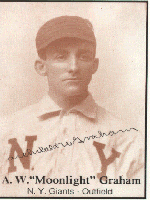
One hundred years ago today, on 29 June 1905, the New York Giants played the Brooklyn Superbas (later known as the Dodgers) and won 11-1. Playing in what was his first and last major league game was Archibald Wright "Moonlight" Graham. He played in the outfield, had no at bats and likely never touched the ball. He would later be sent back down to the minor leages and eventually left baseball alltogether to return to medical school.

Many decades later author WP Kinsella would run across Moonlight's entry while flipping through the Baseball Encyclopedia. His eye would catch on the one line entry full of zeros:

Moonlight Graham

Hitting Statistics

Team

G

AB

R

H

2B

3B

HR

RBI

BB

IBB

SO

SH

SF

HBP

GIDP

AVG

OBP

SLG

1905 Giants

1

0

0

0

0

0

0

0

0

-

-

0

-

0

-

.000

.000

.000

Career

G

AB

R

H

2B

3B

HR

RBI

BB

IBB

SO

SH

SF

HBP

GIDP

AVG

OBP

SLG

1 Year

1

0

0

0

0

0

0

0

0

-

-

0

-

0

-

.000

.000

.000


He would research Moonlight's life and later use him as a character in his masterpiece baseball novel Shoeless Joe, which was later made into the classic baseball film Field of Dreams.

Happy anniversary, Moonlight!

UPDATE:
In honor of Moonlight's anniversary, the Minnasota Twins held "Moonlight Graham Day" today. From www.kare11.com:
Veda Ponikvar is 85-year-old, but she remembers him well as the man who gave her an inoculation for scarlet fever. She was only a third grader at the time.

Archie Graham died in 1965 after executing a groundbreaking study of his patient’s blood pressures. Ponikvar says the generous man, who bought countless blue hats for his wife Alicia, was ahead of his time in medicine.

“(He) believed in a wellness program back in 1916 and 17 when it was absolutely unheard of.”

In the Hollywood film, the ghost of Moonlight Graham finally fulfills his dream. He gets to bat against a major league pitcher on Costner’s Iowa field.

Wednesday, at the Metrodome, the real man was honored by the Minnesota Twins with “Moonlight Graham Day. Every fan at the game received a replica baseball card bearing the only picture known to exist of Moonlight Graham in a Giants uniform.

The picture has been guarded for decades by that former third grader he inoculated against scarlet fever. Ponikvar grew up to be a legend in her own right.

Veda Ponikvar published the Chisholm Free Press for 50 years. She has been one of the most influential Iron Rangers during those years. She remembers the man she always calls “Dr. Graham” as a kind, gentle, man who was generous to a fault and never mentioned his moment in the majors.

Wednesday, the Twins honored his generosity by donating $500 to a scholarship fund named in Moonlight’s honor.

The old physician believed strongly in education. Ponikvar says he would have delighted in seeing two Chisholm children introduced as this year’s scholarship winners. He would also have heard his name cheered by thousands, as his old patient and friend threw out the first pitch.

“I only wish,” Ponikvar sighed as she gripped the baseball, “that he were living to be a part of the glory and euphoria that is just overwhelming this Metrodome in his honor. He really needs to be recognized for not only his time in athletics, but what he did as a doctor.”

Ponikvar thinks the movie did Graham’s memory justice. When Costner’s character suggests to the old ghost that it was a tragedy that his diamond career lasted just five minutes, Graham replies “No. If I had only been a doctor for five minutes, that would have been a tragedy”.

It was that Archibald Graham who was honored and remembered by the Twins and their fans on the 100th Anniversary of his major league appearance.

Topic:

Thoughts on Sacred Spaces, Baseball and the Kotel

My recent visits to the former sites of Hilltop Park and the Polo Grounds has had me thinking about Eliade's theories regarding "sacred spaces" and the way my former instructor Del deChant describes baseball as a "secular religion." I realised that these places are sacred to me by virtue of what took place there many years ago. But this sacredness is relative to the perception of the person seeing them. To others not initiated into my world of baseball I was visiting a housing project and a medical center, but to me I was visiting a place where baseball used to live. I was visiting history. Just as, I can imagine, an uninitiated person might wonder why people come to Jerusalem from all over the world to visit an old wall. To them it is at most a historical curiosity, but to Jews it is the place where God used to live.


Topic: , ; .

Monday, June 27, 2005

My Heart's in the Highlands...

Continuing my tour of things that aren't there anymore, I returned to Washington Hieghts this morning to visit the former site of Hill Top Park. Hill Top Park, so named because it was built on one of the highest points in Manhatten, was the home to the first American League team to be based in New York: The New York Highlanders. The name "Highlanders" had been picked to play off of the fact that the team was based so far north in Manhatten. As it happened the name was seen as being too long for Newspaper headlines and reporters began refering to the team by a nickname that also played on the teams "northern" home: The Yankees. The Highlanders made thier home in Hill Top Park from 1903 until 1912 when they began sharing the Polo Grounds (IV) with the NY Giants. They would stay at the Polo Grounds until 1923 when they would move into Yankee Stadium in the Bronx.

New York Presbyterian Hospital
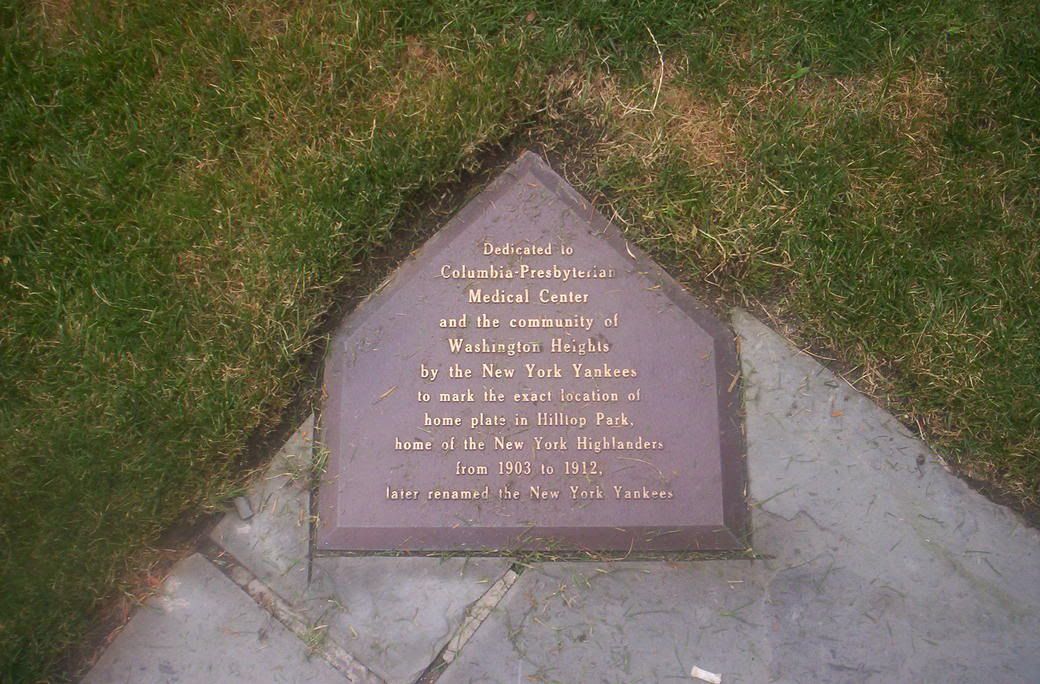
(Formerly Columbia Presbyterian) now occupies the site where Hill Top Park once stood. Below are a couple of pictures I took of the plaque which marks the approximate location where Hill Top Park's home plate sat:

Image hosted by Photobucket.com

Image hosted by Photobucket.com

UPDATE:
For reference here are a couple pictures of Hilltop Park via Ballparks of Baseball:


Topic: ;

Sunday, June 26, 2005

No Man Sees My Face And Lives...

"One day we'll be peering into our microscopes and find God looking back at us. And the first one to blink will lose his testicles."
-Peter O'Toole in Creator

Topic:

Nothing is Real...

While on my little adventure today I also visited Strawberry Fields, the memorial to John Lennon in Central Park. Below are some pictures of it and the Dakota, where John and Yoko lived in the late 70s and in front of which he was shot in December 1980.

Image hosted by Photobucket.com

Image hosted by Photobucket.com

Image hosted by Photobucket.com

Image hosted by Photobucket.com

Image hosted by Photobucket.com


Topic:

"Ray, do you think the Polo Grounds might just be floating around out there?"

I went out for a little sight seeing adventure today. I had wanted to visit the site of Hilltop Park--the original home of the New York Highlanders (aka The New York Yankees) from 1903-1912. New York Presbyterian Hospital was built on the site and they have a plaque on the grounds marking where home plate used to be. Unfortunately the area where the plaque is isn't open to the public on the weekends so I will have to visit again during the week.

My trip uptown wasn't a complete loss, however, I did visit the former site of the Polo Grounds (II, II; IV), the baseball park that was home to the NY Giants (II, from 1889-1890; III from 1891-1911; IV from 1911-1957), the Yankees (From 1913-1922) and the Mets (From 1962-1963). These pictures were taken from Coogen's Bluff in Highbridge Park, which overlooked the Polo Grounds. In the distance you can see Yankee Stadium across the Harlem River.

Image hosted by Photobucket.com

Image hosted by Photobucket.com

Image hosted by Photobucket.com

Image hosted by Photobucket.com

These last two pictures were taken from in front of the Polo Grounds Towers, which were built on the site after the Polo Grounds IV was torn down.

Image hosted by Photobucket.com

Image hosted by Photobucket.com

The only thing that still exists from the old ballpark is a staircase that runs up Coogan's Bluff. Sadly, due to the park being badly neglected, the staircase is blocked off.

Update:
For reference, here are a couple pictures of the Polo Grounds IV:

And a satellite view of the Polo Grounds Towers via Google Maps:
Image hosted by Photobucket.com

Topic: , ;

Saturday, June 25, 2005

Servey Shows Most Doctors Believe in God

From Religious News Online:

A survey examining religion in medicine found that most U.S. doctors believe in God and an afterlife — a surprising degree of spirituality in a science-based field, researchers say.

In the survey of 1,044 doctors nationwide, 76 percent said they believe in God, 59 percent said they believe in some sort of afterlife, and 55 percent said their religious beliefs influence how they practice medicine.

"We were surprised to find that physicians were as religious as they apparently are," said Dr. Farr Curlin, a researcher at the University of Chicago's MacLean Center for Clinical Medical Ethics.

"There's certainly a deep-seated cultural idea that science and religion are at odds," and previous studies have suggested that fewer than half of scientists believe in God, Curlin said Wednesday.

A previous survey showed about 83 percent of the general population believes in God.

But while medicine is science-based, doctors differ from scientists who work primarily in a laboratory setting, and their direct contact with patients in life-and-death situations may explain the differing views, Curlin said.

Belief in "a supreme being ... is vitally important to physicians' ability to take care of patients, particularly the end-of-life issues that we deal with so often," said [Dr. J. Edward] Hill, a family physician from Tupelo, Miss.

Religions among physicians are more varied than among the general population, the survey found. While more than 80 percent of the U.S. population is Protestant or Catholic, 60 percent of doctors said they were from either group.

Compared with the general population, more doctors were Jewish — 14 percent vs. 2 percent; Hindu — 5 percent vs. less than 1 percent; and Muslim — almost 3 percent vs. less than 1 percent

The full story can be read here.


Topic:

Friday, June 24, 2005

You Pledged Allegiance to What?!

This is probably old news to many out there, but I've only just run across it today. Apparently the author of the Beauty Dish blog was called into her son's school because he had been suspended for a day. To quote from her blog entry about the incident:

The principal met me in her office. She closed the door tightly behind me and invited me to sit in a stuffed orange vinyl chair.

"Mrs. Jaworski, 8 has been suspended from school for one day." She wore an arctic blue power jacket over black slacks, and I self-consciously tried to pull my hooded sweatshirt further over my pink pajamas...

"What did he do?" I picked at the hem of my sweatshirt, looked just to the right of her face. I couldn't meet her eyes. I felt nervous. I felt underdressed. I wondered where 8 was.

So she told me what he did. And as she told me, I started to laugh. I didn't laugh a little, either, but I belly-laughed and grabbed my stomach. My son stood with his class this morning, put small right hand over heart, faced the American flag, and recited his own personal pledge of allegiance:

I pledge allegiance to the flag of the United Federation of Planets, and to the galaxy for which it stands, one universe, under everybody, with liberty and justice for all species.

I don't even know what to say about this. She's also set up a on-line store where people can buy gear with her son's pledge printed on them...


Topic:

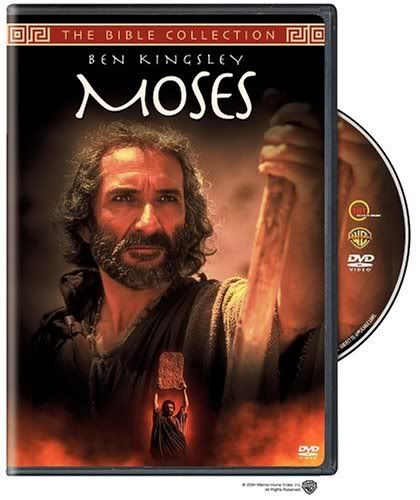
Abraham, Jacob, Joseph and Moses on DVD

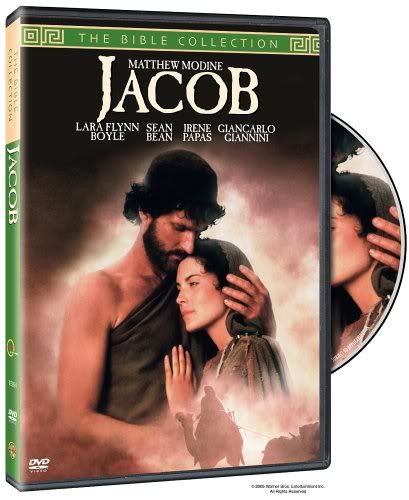
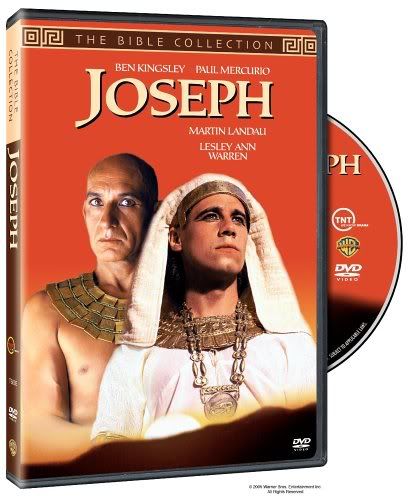
I have recently become aware that a few of my favorite Biblical movies are now available on DVD for the first time. If memory serves these were originally made-for-cable and broadcast on TNT. The only one I've seen since the original broadcast is 'Abraham,' which I rented on VHS a few years ago. I remember them being very faithful and very well done adaptations of the Biblical stories and highly recommend each of them:


Topic: , , , , ;

Tuesday, June 21, 2005

Judeo-Christian? Judeo-Islamic? Christo-Islamic?

DovBear has a couple facinating posts on the relative appropriateness of the term "Judeo-Christian" and the similarities and differences between Jews, Muslims and Christians:


Topic:

Friday, June 10, 2005

Bob Dylan and the Bible

JewsRock.org has a nice article about Bob Dylan's Biblical and Jewish influences:


Topic:

Monday, June 6, 2005

JewsRock.org

Ran across this site while surfing yesterday. I seem to recall hearing of it when it was in the planning stages, but this is my first time seeing it up and running. Very cool stuff:

"Jewsrock.org is a non-profit group devoted to illuminating the intersection of rock and roll and Jewish culture. We've heard a lot about what the Jews have contributed to science, literature, the fine arts--all the high brow stuff. Well, we're going low. Today, we’re a website, filled with original essays, photographs, trivia, lyrics, Q & As, and, if you haven’t noticed it already, a Jewish rock quiz. And this is just the beginning. Soon, we will be bringing live programs to cities across the country. We plan also to design a one-day history lesson in Jews and rock for Hebrew schools. By next year we hope to execute our plan for total global domination. Until then, though, we’re a website. But—as you will soon see—one helluva Jewish website."

Topic: ,

Sunday, June 5, 2005

Wonders Instead of Hapiness

כ’האבּ געבּעטן ווּנדער אנשטאט גליק אין דוּ האסט דיי מיר געגעבּן
"I prayed for wonders instead of hapiness,
and You gave them to me."
- Abraham Joshua Heschel, 1933
the epigraph to
דער שם המפורש: מענטש - לידער
(The Ineffible Name of God: Man - Poems)


Topic:

The background image on this page is a Hebrew translation of the verse from Bob Dylan's song  It's Alright, Ma (I'm Only Bleeding), from which the title of this blog is taken. Translation courtesy of Yoram Aharon of Hod-HaSharon's page--found via YudelLine-- which has many Dylan lyrics in Hebrew.