Pages

Sunday, January 30, 2005

That Book Meme

  1. Grab the nearest book.
  2. Open the book to page 123.
  3. Find the fifth sentence.
  4. Post the text of the sentence in your journal along with these instructions.
  5. Don’t search around and look for the “coolest” book you can find. Do what’s actually next to you.

“Genuine religiosity is doing.” - From the Martin Buber Reader: Essential Writings, Edited by Asher D. Biemann, which I'm reading for the class I'm taking this term on the philosophy of Buber.

Via Plum Crazy

Thursday, January 27, 2005

60th Anniversary of Auschwitz Liberation

From PRIMER:

January 27th - The 60th anniversary of the Liberation of Auschwitz

Auschwitz, the worst of the death camps, occurred in the wake of The Holocaust, symbolized by consistent, systematic, unrelenting anti-Jewish propaganda campaign. As a result, the elimination of the Jews from German society was accepted as axiomatic, leaving open only two questions: when and how.

"We know that for the dead it is too late. For them, abandoned by God and betrayed by humanity, victory did come much too late. But it is not too late for today's children, ours and yours. It is for their sake alone that we bear witness."

------Elie Wiesel, speaking at the United Nations, marking the 60th anniversary of the liberation of the Auschwitz death camp.

As Germany expanded its domination and occupation of Austria, Czechoslovakia, France, the Low Countries, Yugoslavia, Poland, parts of the USSR, Greece, Romania, Hungary, Italy and others countries, the way was open for Hitler to realize his well-publicized plan of destroying the Jewish people.

After experimentation, the use of Zyklon B on unsuspecting victim was adopted by the Nazis as the means of choice, and Auschwitz was selected as the main factory of death (more accurately, one should refer to the “Auschwitz-Birkenau complex”). The green light for mass annihilation was given at the Wannsee Conference, January 20, 1942, and the mass gassings took place in Auschwitz between 1942 and the end of 1944, when the Nazis retreated before the advancing Red Army. Jews were transported to Auschwitz from all over Nazi-occupied or Nazi-dominated Europe and most were slaughtered in Auschwitz upon arrival, sometimes as many as 12,000 in one day. Some victims were selected for slave labour or “medical” experimentation. All were subject to brutal treatment.

In all, between three and four million people, mostly Jews, but also Poles and Red Army POWs, were slaughtered in Auschwitz alone (though some authors put the number at 1.3 million). Other death camps were located at Sobibor, Ch elmno, Belzec (Belzek), Majdanek and Treblinka.

Auschwitz was liberated by the Red Army on 27 January 1945, sixty years ago, after most of the prisoners were forced into a Death March westwards. The Red Army found in Auschwitz about 7,600 survivors, but not all could be saved.

For a long time, the Allies were well aware of the mass murder, but deliberately refused to bomb the camp or the railways leading to it. Ironically, during the Polish uprising, the Allies had no hesitation in flying aid to Warsaw, sometimes flying right over Auschwitz.

There are troubling parallels between the systematic vilification of Jews before the Holocaust and the current vilification of the Jewish people and Israel. Suffice it to note the annual flood of anti-Israel resolutions at the UN; or the public opinion polls taken in Europe, which single out Israel as a danger to world peace; or the divestment campaigns being waged in the US against Israel; or the attempts to delegitimize Israel’s very existence. The complicity of the Allies in WW II is mirrored by the support the PLO has been receiving from Europe, China and Russia to this very day.

If remembering Auschwitz should teach us anything, it is that we must all support Israel and the Jewish people against the vilification and the complicity we are witnessing, knowing where it inevitably leads.

This message is being simultaneously posted on over 140 websites worldwide. For a list of
participants, click here.

Parashat Yitro Commentary by Rabbi Schorsch

From learn.jtsa.edu:

P A R A S H A C O M M E N T A R Y
Parashat Yitro 5765
Chancellor Ismar Schorsch
Exodus 18:1 - 20:23
January 29, 2005 19 Shvat 5765

Read the Parashah | Read the Haftarah

This is a reprint of Dr. Schorsch's commentary from 5756.

Judaism is an elaborate way of relating to God as the source of existence and the provider of ultimate meaning. Nothing could be more fatuous than the all too common notion that observance is possible without faith; that one might meticulously heed the minutiae of Jewish practice without any belief in a supreme being. Hence, the Ten Commandments begin with an affirmation of God's reality. "I the Lord am your God who brought you out of the land of Egypt, the house of bondage" (Exodus 20:2).

For Nachmanides, the great thirteenth century exegete, this is the first of the commandments, the sacred soil in which the others are planted. It is history as theological preamble. Israel had witnessed an unalloyed manifestation of God's love so overwhelming that, according to the Midrash, any lowly maidservant at the Sea of Reeds saw more of God than the prophets Isaiah and Ezekiel ever did. To avow this fundamental principle of faith (i.e., the first commandment) is to submit to the governance of God. Acceptance of God's kingdom (malkhut shamayim) precedes submission to the restraint of God's commandments (ol mitzvot).

Divine sovereignty is precisely what Pharaoh had mocked at the outset of his titanic power struggle with Moses: "Who is the Lord that I should heed Him and let Israel go? I do not know the Lord, nor will I let Israel go" (Exodus 5:2). The first of the Ten Commandments takes us right back to Egypt and the basic political issue at the heart of the conflict. It is not a matter of oversized egos in battle, but the limits of human authority.

The first commandment ends with the resonant phrase, "from the house of bondage (mi-beit avadim)." Both Rashi and Nachmanides stress: in Egypt, the Israelites were slaves (avadim) to Pharaoh; now they are the servants (avadim) of God, as the Torah says later: "For it is to Me that the Israelites are servants: they are My servants, whom I freed from the land of Egypt, I the Lord their God" (Leviticus 25:55). God's intervention is a direct challenge to Pharaoh's claim of absolute authority over human life. No man has the right to enslave another. The Exodus from Egypt is a revolutionary act of universal import. All human power is derivative and, therefore, restricted. God alone is the seat of absolute sovereignty. What has occurred in "the house of bondage" is a monstrous abuse of power.

The issue is sharpened in the Torah by the use of the same Hebrew word avod for subservience both to Pharaoh and to God, but with a decisive change in meaning. When Pharaoh first heard the modest request of Moses for a respite (to take Israel into the wilderness to offer sacrifices to God), he intensified the severity of their working conditions: "You are shirkers, shirkers! That is why you say, 'Let us go and sacrifice to the Lord.' Be off now to your work (ivdu — an imperative form of our verb). No straw shall be issued to you, but you must produce your quota of bricks" (Exodus 5:17-18)!

Not without design, Moses employs the same verb in his oft-repeated demand of Pharaoh: "Let My people go that they may worship Me (va-yaavduni)" (Exodus 7:16, 26, 18:16, 9:13, 10:4). To serve Pharaoh without rest or remuneration is slavery, the most abysmal form of human degradation. To serve God is to enhance human dignity.

Similarly, it is not accidental that the first topic taken up after Sinai in Parashat Mishpatim deals with the institution of slavery, rendering it of limited duration and vastly more humane (Exodus 21:1-12). The experience of bondage in Egypt, a system of human exploitation without bounds, prepared Israel to offer the world a conception of human authority drastically restricted.

For the Torah, absolute power is the prerogative of God alone, before Whom all human beings are equal. Theocracy blunts the arrogance of human power. The only form of kingship tolerated is that of a constitutional monarch, who is to be a lifelong student of God's law, and to rule without the trappings of power such as great wealth, many wives and a plethora of horses. Nor was he above criticism. The prophets dared repeatedly to excoriate his acts of excess and injustice. The kind of supreme and sacred power personified by Pharaoh was anathema to the Torah.

Suspicious of every instance of concentrated power in human hands, the Torah slightly deprecates the portrait of Moses. In our parashah, he falls far short of being a consummate administrator. Just prior to meeting God face-to-face atop Mount Sinai, we find Moses taking advice, like any other mortal, from his Midianite father-in-law on how best to administer justice to his people — a deftly ironic juxtaposition of scenes. No matter how close to God, Moses is not without blemish. A minor and enigmatic sin denies him the ultimate fruit of his labor, leading Israel into the Promised Land, and his place of burial is intentionally concealed to prevent it from ever becoming a popular shrine.

Likewise, the Rabbis eliminate any reference to Moses in the ceremonial retelling of the Exodus at the seder table (in the Haggadah). Nor do they permit the parashah in which he alone ascends Mount Sinai to receive the Torah to bear his name, although it easily could have, since his name is the sixth word of the parashah.

Solzhenitsyn writes somewhere that, "It is thanks to ideology that it fell to the 20th century to experience villainy on a scale of millions." Indeed, the numberless victims of totalitarianism and genocide exceed our capacity to imagine and protest their suffering. The ghost of Pharaoh continues to haunt the earth, donning ever-new garbs. And arrayed against him still is the ancient vision of the Torah which animates the concluding prayer of each and every Jewish service:

We therefore hope in You, O Lord our God, that we may soon behold the glory of Your might, when You will remove the abominations from the earth and when all idolatry will be abolished. We hope for the day when the world will be perfected under the kingdom of the Almighty, and all humankind will call upon Your name.

Shabbat shalom,

Ismar Schorsch


The publication and distribution of Dr. Schorsch's commentary on Parashat Yitro are made possible by a generous grant from Rita Dee and Harold (z"l) Hassenfeld.


Copyright © 2005 Jewish Theological Seminary
Comments to learn@jts web team.

Sunday, January 23, 2005

What is God's Game?

"God does not play dice with the universe."

"Not only does God play dice, but he sometimes throws them where they cannot be seen."

"God does not play dice with the universe: He plays an ineffable game of His own devising, which might be compared, from the perspective of any of the other players,* to being involved in an obscure and complex version of poker in a pitch-dark room, with blank cards, for infinite stakes, with a Dealer who won't tell you the rules, and who smiles all the time.

* i.e., everbody."

Finally, a Fair and Balanced Report from FOX

Fox News anchor Bridgette Quinn discussed the Bush inaugural with Judy Bachrach of Vanity Fair live on TV and was quite shocked when Ms Bachrach actually spoke up against the lavish party. In fact Quinn looked absolutely panicked as Bachrach veered from the scripted talking points:

Here is the full transcript of the conversation, thanks to a boy and his computer:

Quinn: ...the festivities, Judy Bachrach, contributing editor at Vanity Fair Magazine. Judy, welcome to you. We were noticing all the snow in Washington... it's really coming down! I hope that doesn't put a crimp in anybody's plans. Look at that gorgeous shot of the White House.

Bachrach: Well, I have a feeling that maybe it should put a crimp, or at least something should put a crimp in the plans of the White House, they have such a very lavish inaugural, at a time of war, um...

Quinn: Really?

Bachrach: Yes.

Quinn: Oh, OK.

Bachrach: What I've noticed is, the worse a war is going, the more lavish the inaugural festivities. When Franklin Delano Roosevelt was president, during a time of war, of course, as you know, he had a very modest inauguration and a very tiny party, where he served chicken salad, or where chicken salad was served. And that was when we were winning a war.

Quinn: Right, but --

Bachrach: It seems like -- sorry.

Quinn: -- well, no, I, but look, the president has addressed this, hasn't he? He said that this is a, I believe a quote, was that we're celebrating, we're celebrating democracy, we're celebrating a peaceful transfer of democracy, what's wrong with doing that?

Bachrach: Um, have you noticed any peace or any transfer of democracy in Iraq? If you have, you're the first person to have seen it --

Quinn: Well, I've noticed the elections coming up, and Judy, to be honest with you, I really didn't want to --

Bachrach: --don't seem very peaceful.

Quinn: --argue politics with you this morning, you know, just wanted to get --

Bachrach: Oh, really, I thought I was allowed to talk about what I wanted to talk about.

Quinn: You cer-- you certainly have that right, uh, let me ask you this, what, I mean, what, what should they have cut back on? I mean, we have lavish inaugurations --

Bachrach: How about 40 million dollars?

Quinn: All right, so how would you --

Bachrach: We have to --

Quinn: --what would you, how would you plan it --

Bachrach: May I say something?

Quinn: How would you plan it?

Bachrach: May I say something?

Quinn: Sure.

Bachrach: May I say something? We have soldiers who are incapable of protecting themselves in their Humvees in Iraq. They have to use bits of scrap metal in order to make their Humvees secure. Their Humvees are sitting ducks for bombs. And we have a president who's using 40 million dollars to have a party. That's a start.

Quinn: Judy, what would you suggest for the inauguration? How would you do it?

Bachrach: How about a modest party, just like FDR. I'm sure you'll agree he was a pretty good president, with a fine sense of what's appropriate and what's not. And during a time of war, ten parties are not appropriate. When your own soldiers are sitting ducks, in very, very bad vehicles.

Quinn: Don't you think that the president has given his proper respect to our troops? I mean, yesterday, as far as I can tell --

Bachrach: Respect means keeping them secure.

Quinn: -- the festivities opened with a military gala, they ended with a prayer service, there just seem to have, certainly been a tremendous effort over the past couple of days, and more than that, to honor our troops.

Bachrach: Well, gee, that prayer service should sure keep them safe and warm in their flimsy vehicles in Iraq. I'd rather see that money going to them, rather than to a guy who already is president for the second time, and --

Quinn: All right, Judy Bachrach, I think we've given you more than your time to give us your point of view this morning.

Bachrach: Well, thanks for having me on.

Quinn: All right.

Video of the broadcast is available here. Much thanks to DovBear for the tip.

RIP Johnny Carson, 1925-2005

From Yahoo! News:

WASHINGTON (Reuters) - Legendary television entertainer Johnny Carson has died of emphysema at age 79, the NBC television network reported on its Web site on Sunday.

Carson hosted NBC's popular "The Tonight Show" for nearly 30 years, long dominating late-night television with an estimated 12 million viewers each night. He did his final show on Friday, May 22, 1992, seen by 55 million, and was replaced the next Monday by the current host, Jay Leno.

Sidekick Ed McMahon introduced him nightly with the rallying cry of "Heeeeeeere's Johnny!" Carson's blend of humor, music and conversation was the last thing millions of Americans heard before drifting off to sleep.

"I am one of the lucky people in the world. I have found something I liked to do, and I have enjoyed every single minute of it," a teary-eyed Carson said as he closed the show for the last time. "I bid you a very heartfelt goodnight."

In later years, Carson became something of a recluse in his Malibu, California, home, rarely venturing into the public eye.

After a 1999 quadruple bypass heart operation, Carson cut back on his tennis and discontinued his annual treks to Africa, the French Riviera and the Wimbledon tennis tournament. He had battled emphysema for years.

File photo showing talk show host David Letterman (R) with Johnny Carson during a May 13, 1994 taping of Letterman's 'Late Show' in Los Angeles, California. Carson died at the age of 79 the NBC television network reported on its Web site on January 23, 2005. Born October 23, 1925, Carson was known as the king of late night television for three decades, hosting nearly 5,000 episodes of 'The Tonight Show' on the NBC network.  (CBS via Reuters)
Johnny with Dave Letterman in 1994

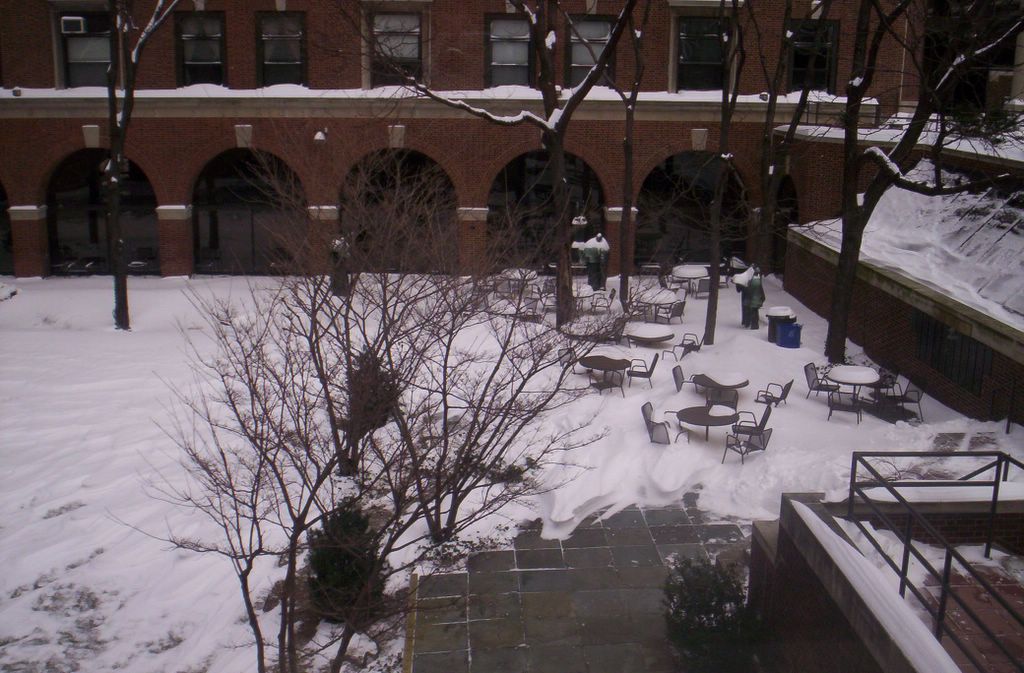
Snow, Snow, Snow and Wind


The JTS Courtyard from ground level Posted by Hello


Another shot from the 2nd floor Posted by Hello


The JTS Courtyard from the 2nd floor Posted by Hello


Another shot of the courtyard. Posted by Hello


The JTS Courtyard from the Kripke Tower. As you can see, the wind has been blowing very hard all night. Posted by Hello

Saturday, January 22, 2005

JTS Snow


The JTS courtyard and Library Building Posted by Hello

New York Snow


The view from my window looking up north Broadway into the blizzard. Posted by Hello

Friday, January 21, 2005

New On-Line Septuagint

www.zhubert.com has a great on-line edition of the septuagint now available, as well as the Greek NT. I've only taken a cursory look at it, but it looks excellent. One feature that stood out was that when you hover your cursor over a word you get a translation plus grammatical information. Very good stuff.

Thanks to Jim Davila for the tip!

Monday, January 17, 2005

Hebrew Comic Book Reviews and News

http://www.superheroesetc.co.il/ offers comic book reviews and news in Hebrew. Good for Hebrew speaking/reading comic fans, as well as those looking for a place to practice thier Hebrew.

A Torah Focussed Laser

From Chabad.org's Daily Dose mailing list:

 
B"H


Laser Power
-----------

People have the wrong idea about restrictions: They imagine that if you restrict what you eat and what you do not, when you work and when you meditate and pray, what you wear, where you go -all these restrictions will suffocate any sense of inspiration.

The truth is, without any restrictions your inspiration will quickly dissipate. Focus your light like a laser into an intense, powerful beam and it will last.

A Daily Dose of Wisdom from the Rebbe
-words and condensation by Tzvi Freeman
Shevat 6, 5765 * January 16, 2005

The background image on this page is a Hebrew translation of the verse from Bob Dylan's song  It's Alright, Ma (I'm Only Bleeding), from which the title of this blog is taken. Translation courtesy of Yoram Aharon of Hod-HaSharon's page--found via YudelLine-- which has many Dylan lyrics in Hebrew.